Your team may already be bigger than your employee list suggests.
AI may help prepare content, organize information, route requests, summarize meetings, monitor routine signals, or draft a first response. That support can give a small business more working capacity without assigning every new task to the owner.
But a larger support system creates a leadership question: who decides what the work is for, what good looks like, and when a person needs to step in?
AI can assist with the work. It cannot own the business.
That distinction matters because an AI tool can produce activity without producing a reliable result. A draft can look polished and still miss the customer’s context. A workflow can move quickly and still send the wrong information. A summary can sound certain while leaving out the one detail that changes the decision.
Your growing team may include AI, but it still needs human leadership.
I believe AI should empower people, not replace them. As a Founder, I do not want technology to remove human leadership from the business. I want it to carry more of the repetitive preparation and routine work so people can focus on judgment, relationships, creativity, and the decisions that move the business forward.
Founder freedom does not mean stepping away from responsibility. It means building a business where clear roles, trusted systems, and empowered leaders keep the work moving without every task coming back to the Founder. AI can support that structure, but people must still set the direction, protect the standards, and remain accountable for the result.
More output does not equal better capacity
Owners often notice AI first through speed. A task that took an hour now takes ten minutes. A blank page becomes a draft. Notes become a summary. A backlog becomes a sorted list.
Speed helps, but dependable capacity requires more than output. The work needs a purpose, an owner, an approved information source, a review point, and a way to handle mistakes or unusual cases.
Without those pieces, the owner gets a new kind of overload: checking every result, correcting context, answering exceptions, and figuring out which version can be trusted. The tool saved production time but added management work.
The fix is not tighter prompting alone. The business needs an operating structure around the AI-supported work.
Human leadership starts before the task
Good leadership does not begin with approving an AI output after it appears. It begins before the work starts.
A human leader should define:
- why the task matters and which business result it supports;
- what information the AI may use;
- the standard the result must meet;
- which actions can proceed under an approved rule;
- which decisions require a person;
- what happens when the normal path fails; and
- how the business will review performance over time.
Those choices turn a general tool into bounded business support.
For example, an AI-supported lead-response workflow may prepare a reply using approved service information. A person may still need to handle pricing exceptions, sensitive customer concerns, unusual requests, or any commitment outside the approved service terms. The workflow should name that boundary before a live inquiry arrives.
The same principle applies to internal work. AI may assemble a weekly report, but leadership decides which numbers matter, checks whether the source data is sound, and determines what action follows.

Give every workflow a human owner
“AI handles it” is not an ownership model.
Every customer-facing or business-critical workflow needs a person who remains accountable for the outcome. That person does not have to complete every step manually. They do need enough visibility and authority to set the standard, review exceptions, stop a bad path, and improve the process.
The NIST AI Risk Management Framework Core gives organizations a useful structure for this work. Its Govern function calls for clear roles, responsibilities, accountability structures, ongoing monitoring, and human oversight across the AI lifecycle.
For a small business, that can be plain and practical:
- one named owner for the workflow;
- a list of allowed information and actions;
- an approval rule for sensitive work;
- an exception path when the result is uncertain;
- a record of material changes; and
- a regular check of whether the workflow still serves its intended purpose.
This does not require a large policy department. It requires leadership to make the important decisions visible.
Keep people in the decisions that affect people
Some work carries more weight than routine preparation. Hiring, performance, scheduling, pay, customer disputes, refunds, contracts, health information, private data, and public claims can affect people directly.
A business should not treat those decisions as ordinary automation.
The U.S. Department of Labor’s AI principles and best practices call for governance, human oversight, transparency, responsible handling of worker data, and AI systems that assist and complement workers. The guidance is non-binding, but its central lesson applies beyond large employers: people affected by workplace AI should not disappear from the process.
Human review should be meaningful, not ceremonial. A reviewer needs enough context, time, and authority to question the output. If the system makes the real decision and a person can only click approve, the business has not preserved human judgment.
Leadership is also knowing when not to use AI
AI is not the right answer for every task.
A workflow may need empathy, negotiation, physical presence, professional licensing, confidential judgment, or a relationship that customers expect to have with a person. Sometimes the information is too incomplete or the consequences are too high. Sometimes a simple checklist or a clearer handoff works better.
Strong leadership asks whether AI belongs in the workflow at all.
Before assigning a task to AI, consider:
- Is the purpose clear?
- Can the expected result be checked?
- Is the source information approved and current?
- What harm could an error cause?
- Does the task involve a promise, sensitive data, or a consequential decision?
- Who can stop or correct the process?
- Would a person or a simpler non-AI process do the job better?
A “not yet” decision can protect the customer, the team, and the business.
Build feedback into the team
Human leadership does not end after setup. AI-supported workflows change when tools change, source information changes, customer expectations shift, or the business discovers an exception it did not predict.
Schedule a short review rhythm. Look at real work, not a demo.
Ask what the AI prepared correctly, what people had to rewrite, which exceptions appeared, whether response time improved, and whether the owner’s workload actually declined. If the workflow produces more review work than useful support, revise it or stop it.
The point is not to defend the tool. The point is to make the work better.

Human Leads + AI Assists
A clear division of responsibility keeps the model simple.
AI may prepare, organize, route, record, remind, monitor, and draft within approved boundaries. People own judgment, relationships, commitments, sensitive exceptions, priorities, and final decisions.
That is Human Leads + AI Assists.
It gives a small business room to expand capacity without pretending technology can carry accountability. It also gives employees, contractors, and leaders a clearer picture of where they fit. People are not there to clean up whatever the system produces. They lead the work; AI supports defined parts of it.
Start with one workflow
Do not try to reorganize the whole business at once.
Choose one recurring workflow that creates real pressure, such as lead follow-up, customer onboarding, content approval, appointment reminders, inbox routing, or weekly reporting. Name the human owner. Define the purpose, approved information, review points, exception path, and result you want to measure.
Then test with real examples before expanding.
A small, observable workflow will tell you more than a long list of possible AI uses. You will see where the business already has clarity and where it still depends on memory, informal judgment, or the owner stepping in at the last minute.
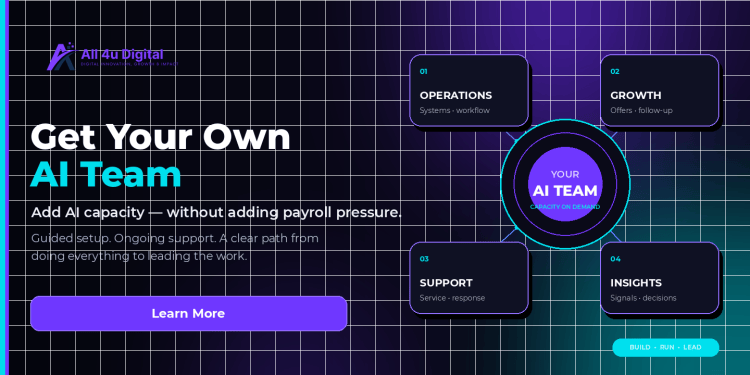
That is readiness work. It creates the structure an AI Team needs before the business asks it to carry more.
Closing
AI can widen the circle of support around an owner. It can help recurring work move with less delay, prepare information before a person needs it, and make routine activity easier to see.
Leadership still sets the direction.
People decide what the business stands for, what customers have been promised, which risks are acceptable, when an exception needs care, and what result is worth pursuing. Those responsibilities do not belong to a tool.
Build the team, but keep leadership human.
AI-assisted content. Human-reviewed and prepared for Founder approval by All4UDigital.

