There is a moment many business owners recognize.
The business is growing. The leads are coming in. Customers are asking questions. Appointments need to be scheduled. Quotes need to be followed up on. Messages are waiting. Tasks are scattered across email, text, notes, memory, and maybe three different tools.
So the owner reaches the obvious conclusion: “I need more help.”
Sometimes that is true.
But before you hire another person, add another contractor, or buy another tool, there is a better question to ask first:
Does your business have a daily operations foundation strong enough for help to actually help?
Because hiring into confusion does not remove pressure. It usually spreads the pressure around.
If the process is unclear, a new person has to keep asking the owner what to do. If follow-up depends on memory, the owner still has to remind everyone. If customer communication has no standard, every message becomes a judgment call. If the business has no clear handoff points, work still falls back on the same person.
That is not growth support.
That is a more expensive version of the same problem.
I’ve learned this lesson firsthand while building my own AI Executive Team.
Like many business owners, I assumed that adding capable AI team members would immediately reduce my workload. Instead, I found myself spending more time reviewing work, answering questions, and coordinating tasks. The problem wasn’t the AI—it was the lack of a clear operational foundation.
Everything changed when I developed my AI Executive System. By giving every executive a clearly defined purpose, responsibilities, approval standards, and handoff points, the team began operating with far greater consistency. Instead of creating more work for me, the system created better oversight, clearer accountability, and far less day-to-day micromanagement.
That experience reinforced an important lesson I now share with every business owner:
Whether you’re building a human team or an AI Team, adding help without first building the right operational foundation doesn’t reduce your workload—it often increases it. The system comes first. Then the team can truly help.
Hiring does not fix a missing operating foundation.
Most overwhelmed owners are not lazy. They are carrying too much invisible work.
They are remembering who needs a callback. They are checking whether the invoice went out. They are answering the same customer questions again and again. They are watching the inbox because no one else knows what matters. They are following up on leads, fixing small misses, approving everything, and trying to keep the business moving while also doing the work only they can do.
At some point, the owner starts thinking the business needs another person.
But many times, what the business needs first is structure.
A daily operations foundation gives the business a clear way to handle the work that repeats every day:
* How new leads are captured.
* How quickly customers are acknowledged.
* Who follows up and when.
* What information gets collected before a call or appointment.
* What tasks can move forward without the owner.
* What still needs owner approval.
* Where customer notes, next steps, and status updates live.
* How the team knows what happened and what comes next.
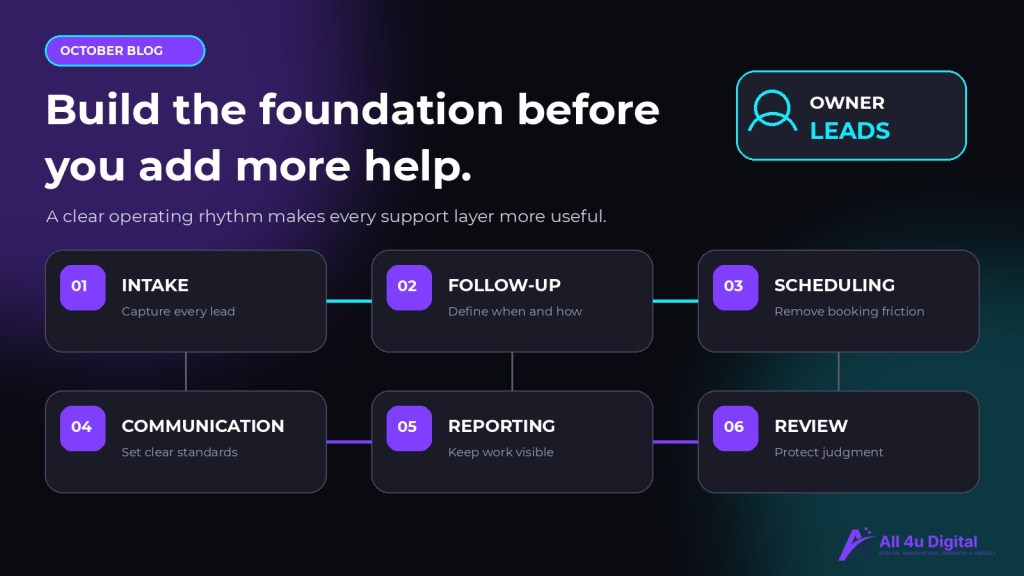
This is the work that keeps a business from becoming owner-dependent at every turn.
AI works better when the business has a clear job for it.
AI can help small businesses move faster, respond more consistently, organize information, and reduce repetitive work.
That is not theory anymore. QuickBooks reported that small and midsized businesses are already seeing AI affect productivity, revenue, and growth.
But AI does not magically organize a business that has no operating rhythm.
If the business cannot clearly explain what needs to happen after a lead comes in, AI will not fix that by itself. If no one has decided when follow-up happens, what the message should say, who reviews the response, or where the next step gets tracked, AI may only create more drafts, more reminders, and more decisions for the owner.
That is why All4UDigital does not treat AI as a pile of tools.
The stronger move is to build AI Team capacity around the actual operating needs of the business.
That means looking at where work slows down, where the owner is still the bottleneck, and where practical support could help the business respond, follow up, route, prepare, and report with more consistency.
Small businesses need capacity without creating more complexity.
Small business owners are already experimenting with AI.
Thryv’s 2026 report found that many small businesses are using AI, but still need more skills and guidance to use it effectively.
That is the real opening.
The question is not “Can AI do something?”
The question is “Where should AI support the business so the owner is not carrying every moving part alone?”
For one business, that may start with lead follow-up.
For another, it may be appointment reminders, customer intake, review requests, email organization, content support, proposal preparation, or weekly reporting.
The best first step is usually not the flashiest one. It is the operating area where inconsistency is costing the business time, money, trust, or owner energy.
Your daily operations foundation should answer these questions.
1. What work repeats every day or every week?
2. Which parts of that work still depend on the owner’s memory?
3. Where do leads, customers, or opportunities wait too long?
4. What information gets lost between tools, people, messages, or tasks?
5. Which decisions truly need the owner, and which only need a clear standard?
6. What would need to be documented before another person could take over?
7. Where could AI help prepare, route, draft, organize, remind, or report without taking final judgment away from the business owner?
If those answers are unclear, hiring may help temporarily, but the business will still feel heavy.
A stronger foundation gives every support layer, human or AI, a clearer role.
AI Team capacity is not staff replacement
Let’s make this plain.
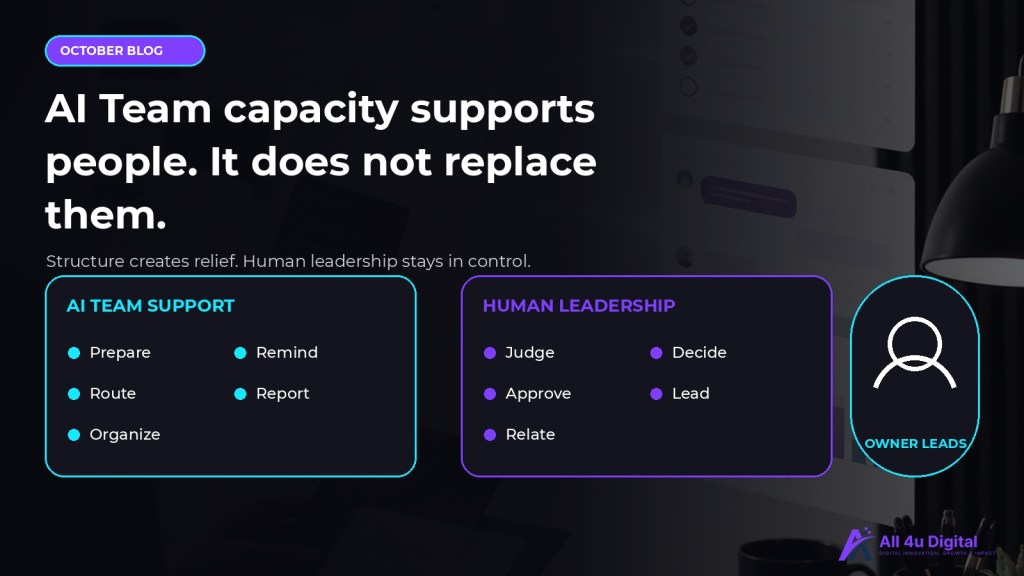
AI Team capacity is not about replacing good people.
It is about giving the business more support around the work that keeps repeating, slipping, or falling back on the owner.
A practical AI Team can help prepare follow-up, organize intake details, draft customer communication, remind the right person about next steps, summarize what changed, flag what needs review, and keep daily work more visible.
But the owner still leads.
The business still needs judgment.
Approval boundaries still matter.
Human relationships still matter.
The goal is not to hand the business to AI. The goal is to stop forcing the owner to be the memory, manager, admin assistant, follow-up system, and emergency catch-all for everything.
Build the foundation first.
If you are considering hiring help, adding software, or expanding your team, pause long enough to look at your daily operations foundation.
You may still need people.
You may still need better tools.
You may need both.
But the order matters.
When your business has clear workflows, handoffs, expectations, and approval rules, support becomes easier to add and easier to manage.
When it does not, every new layer creates more questions.
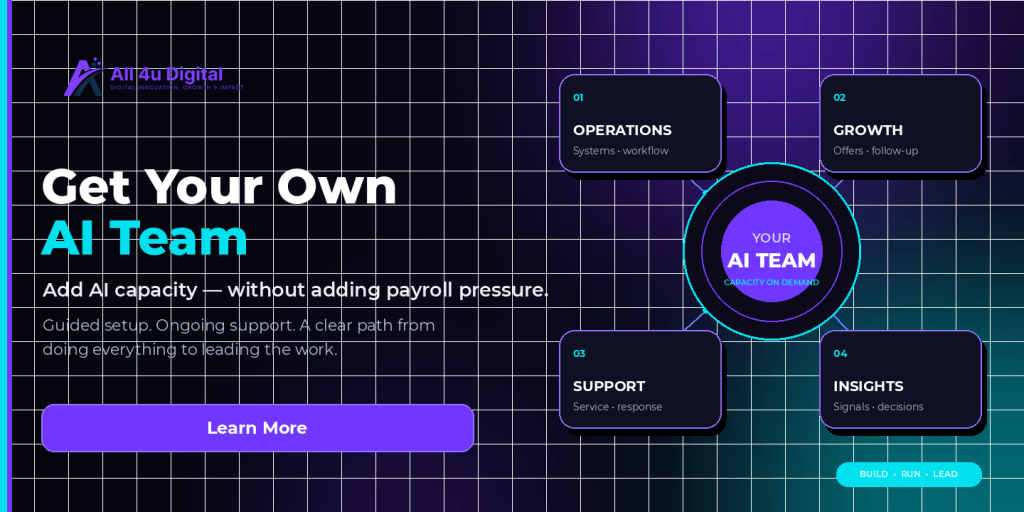
All4UDigital helps owner-led businesses build practical AI Team capacity around daily operations so work can move with more consistency, follow-up does not depend on memory, and the owner has more room to lead.
If you are not sure where your business should start, take the AI Team Readiness Assessment.
It will help you look at your current structure, your operational pressure points, and the areas where AI Team support may create the most relief first.
AI-assisted content. Reviewed and approved by All4UDigital.

